Graph Neural Network Fraud Detection
Overview
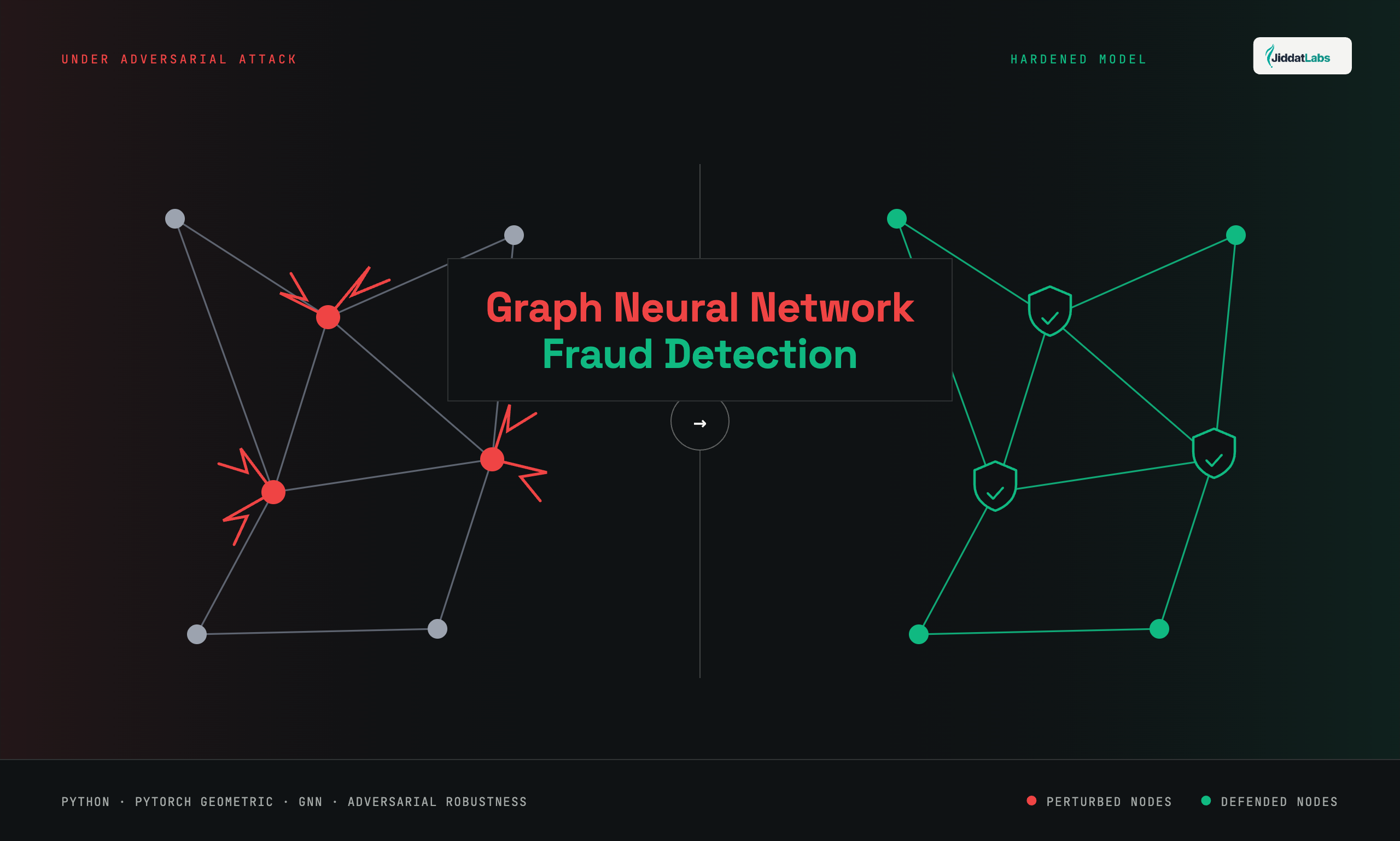
A university research project reimplementing a published Graph Convolutional Network approach to fraud detection, then extending it. The model was trained on a public dataset (80/20 split), attacked with adversarial samples to measure how well it held up, and fine-tuned on those samples to harden it — which improved overall accuracy as well as robustness. The wider subject was adversarial attacks on advanced machine learning and deep learning models.
Outcome
Reproduced the paper's results and improved on them: adversarial fine-tuning left the model both more accurate and measurably harder to fool than the baseline.
Screens & Demos
Architecture & Pipeline
-
01
Published Paper
GCN fraud detection
-
02
Transaction Graph
Public dataset
-
03
Train/Test Split
80 / 20
-
04
GCN Training
PyTorch
- PyTorch
-
05
Adversarial Attack
Robustness probe
-
06
Adversarial Fine-tune
Hardened model
-
07
Evaluation
Accuracy + robustness vs. baseline
End-to-end flow, in order. Scroll sideways on a narrow screen.
Key Features
- Reimplementation of a published GCN fraud-detection paper
- GCN architecture over graph-structured transaction data
- Adversarial attacks used to probe the trained model's robustness
- Adversarial fine-tuning, improving both robustness and accuracy over the baseline
- Studied as part of wider work on adversarial attacks against ML and deep learning